
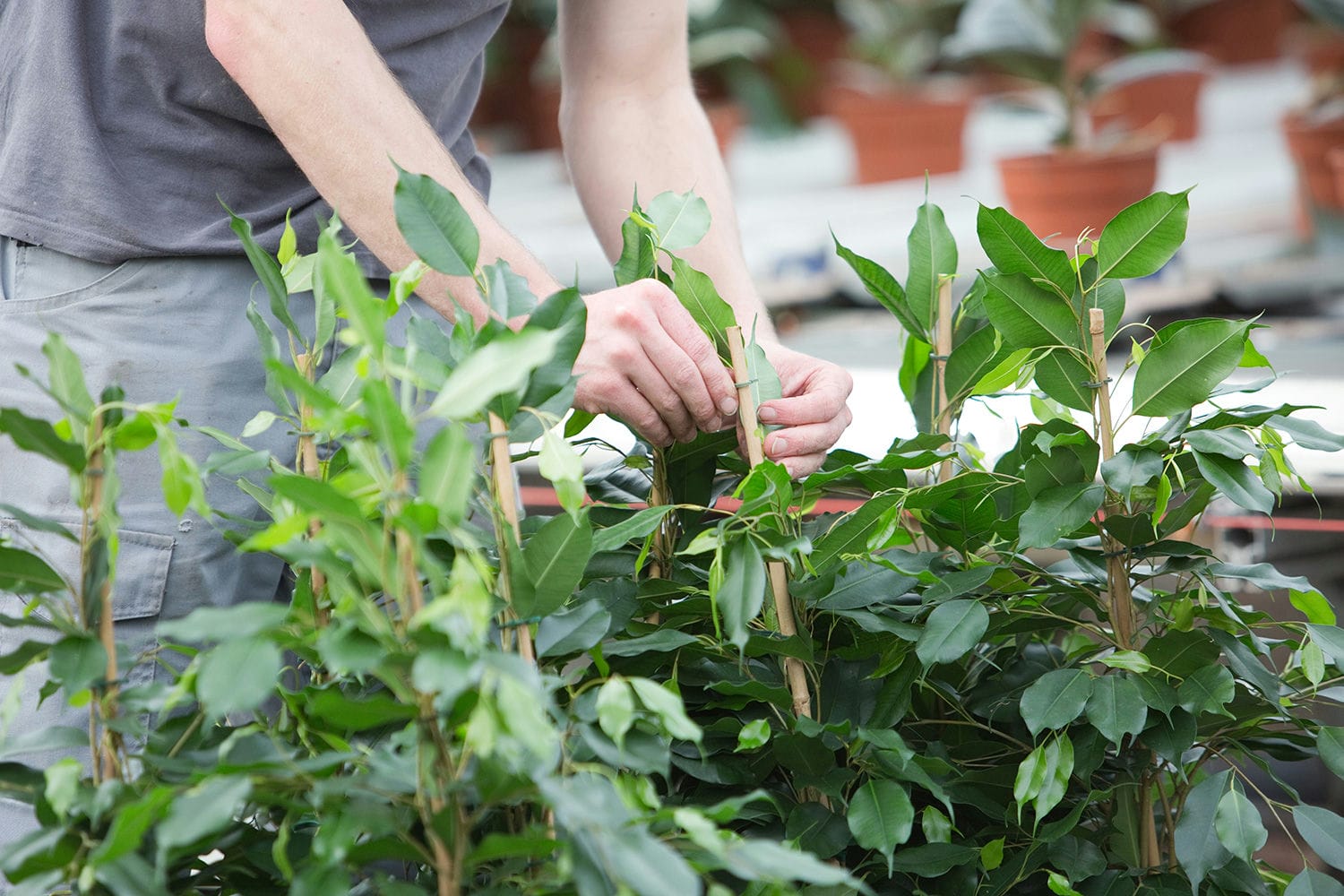
History is repeating itself at Forever Plants. In a slightly different way, perhaps, but certainly along the same lines. When Erik Persoon took over his father’s tomato nursery, he decided that tomatoes were a bit dull to grow. Pot plants – now that was a real challenge! And so it came to pass. Kwekerij Zwethlande, now Forever Plants, became a pot plant nursery. Not for the money. Not for the market. But for the challenge.
Forever Plants has become a different company. The organisation is more transparent and more inclusive. All colleagues get to help decide what happens in the nursery. Financial figures are shared openly and everyone, from management to temporary staff, has a say in the future of the company. Including the future of our cultivation. And that is exactly what we are busy with right now.
Demand-driven growing, but with a twist
We have recently started sending out a questionnaire to all colleagues. For each crop, we ask them how much they enjoy working with it. If they don’t work with that crop, they can skip the question and move on to the next one. It is simply a score from 1 to 10, where 1 stands for ‘terribly boring’ and 10 stands for ‘wonderful to work with’.
The first results are already in and we are already getting an interesting picture of what the various colleagues think of each crop. For some crops there are considerable differences, while for others there is little difference. Some plants receive a very high score, others a very low one.
What are we going to do with this?
Various things! First of all, we are going to look at whether there are correlations between how enjoyable it is to work with certain crops and their actual yields measured per square metre (since some plants are present in larger numbers than others). We also look at correlations between that score and the size, weight of the plant, the quantities, the turnover, the average price and much more.
But more importantly: we are going to let the score people have given weigh in on the choice of crop. Of course, things like market demand, intended result and budgeted margin also come into play, but whether people find it a challenge to work with the plant species is definitely going to be a factor.
Early days
Because we have only just started with this, we still have relatively little clarity. Once all the results are in, there are still plenty of questions we need to answer:
- Suppose a plant species scores insufficiently in terms of challenge, but yields a lot – do we keep it?
- What do we do if a plant species scores extremely high in terms of challenge, but only moderately or barely sufficiently in terms of yield. Do we keep it?
- What will happen to the challenge score of a crop if:
- We indicate even more clearly per crop what it all yields
- We increase or decrease the quantities of the crop
- The price of the crop falls or rises
- We indicate even more clearly per crop what it all yields
- And what are the differences between the various ‘departments’: how does sales think about a crop, for example, compared to someone in the delivery process?
- What happens with a new crop, and will people be able to vote in the future on crops we don’t yet grow?
Repetition is key
In the coming period we will work hard to answer the above questions. So now all of us together are going to do what Erik used to think about on his own: which crop is the most challenging and enjoyable to work with? To compose our assortment optimally, repetition is important. It is exciting, though. Do you know another grower who cultivates on the basis of challenge? We are curious.


